Categories
News

MediNews: Free hearing test app launched for World Hearing Day

More than three million South Africans suffer from permanent, disabling hearing loss. Some might not even be aware of this. Until now. Anyone in South Africa with access to a smart phone and a set of headphones, can now test their own hearing with a clinically valid hearing test app, hearZA™. This proudly SA app was developed and validated by researchers at the University of Pretoria. It is available to download on both the Android and iOS operating systems free of charge. This service has the vision to impact the 1.2 billion globally who suffer hearing difficulties through affordable access and linkage to hearing health. 

Follow these few simple steps to better hearing:

  1. SIMPLE & EASY-TO-USE
    Download the app free of charge on all Android & iOS smartphones and use any headphone set.
  2. DO THE 2 MINUTE TEST
    You will receive your test results immediately after the hearing screening of only 2 minutes. The results will be reported to you on your smartphone and can be viewed on your profile as well.
  3. RECEIVE ACCURATE RESULTS
    The app was developed and clinically validated by the University of Pretoria
  4. KEEP SCORE
    You can keep track of your hearing score. If your results from the hearZA™ indicates a score below normal you should make an appointment for a hearing evaluation at a certified hearing healthcare provider.
  5. MAKE AN APPOINTMENT
    The app will link users diagnosed with a hearing problem to their closest hearing healthcare providers, based on geolocation through their smart phones.
  6. CHALLENGE YOUR FAMILY AND FRIENDS
    Challenge your friends and family with the hashtag #CanYouHearThat challenge and make them aware of the free service.

The theme for World Hearing Day 2017 is “Action for hearing loss: make a sound investment” draws attention to the economic impact of hearing loss.
#WorldHearingDay2017 #CanYouHearThat

Read more:
http://www.hearscreen.com/
http://www.up.ac.za/en/news/post_2240924-free-hearing-test-with-local-app-hearza

Categories
News Welcome to new doctor

Welcome Dr. Ashraf Mohamed

We are very pleased to welcome Dr. Ashraf Mohamed to our team of specialists at Centurion Day Hospital.

Dr. Mohamed has more than 18 years’ experience and practice the full scope of Oral and Maxillofacial Surgery. Dr. Mohamed did both his undergraduate and postgraduate training at the University of the Western Cape. His Maxillofacial surgical training was done at Groote Schuur Hospital and paediatric Maxillofacial training was done at the Red Cross War Memorial Children’s Hospital in Cape Town.

Dr. Mohamed’s rooms are situated in Netcare Unitas Hospital, Suite 303. 
Contact number: 012 664 8144

Categories
News

MediNews: Top tips on how to keep active in the office

We all sit too much. So much that it’s beginning to affect our health. Try these tips to get moving every day to counteract the risks of too much sitting.

Phenomenal advances in technology have made our lives much easier. We can do banking on our cell phones, order food to be delivered to us, communicate to anyone, anywhere from our phone or computer.

However, the side-effect of this is that we now move less. We sit – a lot. For long periods of time.
We drive to work. Sit at a computer all day. Drive home. Sit in front of the TV. Then go to bed. Our physical activity levels have dropped dramatically and research is starting to show the alarming effect this is having on our long-term health.

Studies are even showing that even for people who fit in an hour of exercise a day, if the rest of their day is spent sitting for long periods, their metabolic health is still compromised.
There is much research indicating that ‘sitting time, TV time, and time sitting in automobiles increases premature mortality risk’. Meaning that sitting too much could quite literally be killing you. 

So how do we counteract this when our lifestyles have evolved to the point where we work more than we play? The answer is simply to move – move more and move often. Even if you’re a busy executive with no time for actual exercise. You just need to get a bit creative.

1. Challenge your colleagues: Put technology to good use and use a smart watch or activity tracker to track your daily steps and aim for 10 000 steps a day. Start a friendly competition with your work colleages to track your steps and see who can walk the most in a day, or arrange group walks at lunchtime. Link this to your medical aid and earn active rewards at the same time.

2. Walk and talk: Boardroom meetings are notoriously long and boring, so why not take a meeting for a walk. Even if you don’t leave the building, walk and talk. Apart from the benefit you’ll get from the added movement to your day, the exercise may even spur on some fresh ideas.

3. Stand and work:  If your work environment allows, try prop up your computer on a stand or a higher desk so you have to stand at your desk rather than sitting. Take it one step further and set up your computer on a treadmill set at a low speed and move while you work.

4. Take a break: Set a timer to go off every 30 minutes and make a point of standing up. Even if it’s just to stretch a bit, or to take a walk around the office.  Download an app to remind you, there are many different ones to try including F.lux and Awareness or even Posture Man Pat which monitors your posture through your webcam.

5. Loo workout: Everyone has to go to the loo sometime, so make it your active break time. Take the long route to the loo via the stairs and do 10 squats and 10 push-ups on the basin every time you go.


References:

Too much sitting linked to heart disease, diabetes, premature death; POSTED JANUARY 22, 2015; Julie Corliss, Executive Editor, Harvard Heart Letter; Harvard Health Publications; http://www.health.harvard.edu/blog/much-sitting-linked-heart-disease-diabetes-premature-death-201501227618 

Too Much Sitting: The Population-Health Science of Sedentary Behavior; Neville Owen, Geneviève N Healy, Charles E. Matthews,and David W. Dunstan; National Institutes of Health; https://www.ncbi.nlm.nih.gov/pmc/articles/PMC3404815/# 

http://www.health24.com/Fitness/FitnessGettingStarted/top-tips-on-how-to-keep-active-in-the-office-20161115

Categories
News

MediNews: Your Child and the Dentist

A visit to the dentist can be a scary thing for children. The odors, the tools, the sounds, and the big person with the mask can all upset a child. When choosing a dentist for your child and preparing him or her for a visit, think about the following to make the visit as pleasant as possible.

Choosing a dentist

Pediatric dentists specialize in the care of infants’, children’s, and teenagers’ teeth. They have 2 to 3 years more training to meet the special needs of these age groups. They have special training in making children feel at ease and may have offices designed for children. Whether or not you use a pediatric dentist for your child, asking the following questions can help you pick the right dentist: 

  • What experience does the dentist have with children?
  • Is the office set up for children? For example, does it have children’s drawings on the wall, magazines for children in the waiting room, and smaller furniture? You might want to visit the office to see how it looks.
  • Does the dentist dress the part? Will he or she wear something that puts the child more at ease? For example, if the dentist wears a face mask with children’s illustrations rather than a white face mask, it may help the child relax.
  • Does the dentist provide special programs for children? Membership in the “No Cavity Club” or “Tooth Tots” can make a visit seem more fun.
  • If the dentist has audio headphones, does he or she have children’s material?
  • Does the dentist allow you to be present during treatment? This may be important with young children. But older children and teens may prefer to be on their own.

The dentist’s “chairside manner” is also important:

  • How does the dentist put the child at ease? Techniques that some dentists use include “Tell-Show-Do,” in which the dentist shows and names a dental instrument, shows how it works and tells what it does, and then uses it with the child. Some dentists will pair children of a similar age. They will work with a shy or scared child and a child who is used to the dentist at the same time.
  • How does the dentist start the exam? Many dentists will start with something easy, such as “let’s count your teeth” or making it a guessing game. Your dentist could also ask your child to draw a picture of his or her mouth or of a “rotten” tooth to begin the visit. This helps put your child at ease.
  • Does the dentist praise the child? Saying something good or providing a reward when the child does something “right” helps make a visit to the dentist more positive.
  • How does the dentist deal with problems? Children sometimes misbehave during a visit. The dentist may need to take action to prevent injury. In this situation, the first thing to do is to speak calmly and firmly to the child. If this does not stop the child, or if the child needs to be physically held back, you should know in advance and perhaps help. If you feel your child may act up, talk to your dentist in advance about how to deal with the situation.

Preparing your child for a visit

When your child is old enough to understand a visit to the dentist and have worries or fears, it may be helpful to prepare him or her to limit or overcome any anxiety. This first visit can set the tone for all future visits. Here are some things you can do:

  • Talk to your child about the visit. Explain what will happen, but make it simple. Tell your child that the dentist will “count” and “take pictures” of his or her teeth.
  • Don’t communicate any fear you have to your child. Don’t talk about how the dentist scares you or how bad your last visit was. Don’t use words like “shots,” “drills,” or “needles.”
  • Talk to your dentist about any worries your child may have. Work together to help limit them. For example, if you know your child does not like “scary tools,” the dentist may be able to keep them out of sight.
  • Look for books that explain what it is like to go to the dentist. They usually contain pictures to help explain what happens. They also let your child see what the inside of a dental office looks like.
  • Ask your child to draw a picture of his or her mouth or teeth to take to the dentist. Your child can then talk about this to begin the visit.
  • Don’t bribe your child into going to the dentist or use a dental visit as a punishment.

WebMD Medical Reference from Healthwise

ByHealthwise Staff, November 14, 2014

Source: http://www.webmd.com/oral-health/tc/your-child-and-the-dentist-topic-overview#1

Categories
News

MediNews: How to Get Kids to Love Exercise

11 Steps to Get Kids to Love Exercise

Do It Together

Dinner’s over. Instead of heading for the TV room, make a beeline for the front door. Go for a walk or a bike ride. Shoot some hoops or play catch. Just keep the conversation light. This is not the time to go over your child’s grades or chores. If it’s fun for everyone, you’ll all want to keep doing it.

Aim for an Hour a Day

Kids need to move for a total of 60 minutes a day. It should be a mix of activities that:

  • Get the heart pumping (such as running and fast walking)
  • Work muscles (like pushups)
  • Strengthen bones (like jumping rope) 

This hour of exercise doesn’t have to happen all at once. Kids can split it up over the course of the day. Have them take a brisk walk with the dog after school, play on a jungle gym — it all adds up.

Use a Step Counter

Kids love gadgets. A step counter (aka pedometer) can motivate them to move more. Get one for everyone in the family. Then come up with mini-challenges to get moving throughout the day.

How many steps to the telephone pole? How quickly can you take 80 steps?  See if your kids like posting a tally of steps in the kitchen for a little friendly competition, or have them try and beat their personal record.

Grab Some Fun Gear

You don’t need fancy equipment to get your family moving. Sure, a tennis racket or a pair of skates can provide a little inspiration, but a simple, affordable jump rope or an inflatable beach ball can do the trick, too. Keep a hidden stash of new outdoor toys. Then bust ’em out on days when your kids seem bored.

Set the Scene

It sounds simple, but sometimes you just have to choose the right location. Take kids to a playground or a baseball field. Go to the park. Have a picnic by a lake with a few of their friends.
You may not have to do much to get them moving. They may be inspired by their surroundings or other kids.

Shop Around for Classes

Classes — whether aikido or dance, tennis or yoga — can be a great way to get your kids to love physical activity.
Visit some classes for free before you sign up, and let your kids pick their favorite. That way, you know the money is well spent.

Play Video Games? Yes!

When it comes to fitness, video games don’t have to be the enemy. Use a game system with a motion sensor, like the Kinect or Wii. There are lots of games — physical fitness, yoga, sports, dance — you can rent or borrow.

Kids who get up and really move when they play active video games burn up to 200% more energy than they do when they play standard ones sitting down. But it’s still a good idea to limit screen time.

Make It Fun

Grab your child’s hand and go jump in a pile of leaves. You don’t even have to say “exercise.” Plant some tulips. Walk to the library. Make a snowman. Make it a seamless, fun part of their everyday life, not something they “have to” do.

Offer Encouragement

If your child doesn’t take to exercise right away, don’t give up. Praise what they do. Help them try out activities that don’t have to be competitive, like hiking or kayaking.

The key is to help them find their element. Keep trying different sports or activities. Help them see that physical activity is for everybody.

Find Your Passion

If you want your kids to exercise, it helps if you do. If they see you moving, they know it’s an important part of life that can be fun!

So what’s your thing?  Find an activity that youreally enjoy. Then share it with your kids. It’s OK if you haven’t been moving much either. You can start together.

Sneak It In

For example, when you go to the mall, make time to park far away from the entrance. Inside, point out that sometimes it’s better to take the stairs than to wait for the elevator. Race to see who can put away toys first or make the biggest pile of leaves.

Taking any chance to walk, run, jump, and play will make physical activity into a daily habit that becomes second nature to them.

Source: http://www.webmd.com/parenting/raising-fit-kids/move/slideshow-kids-love-exercise

Categories
News

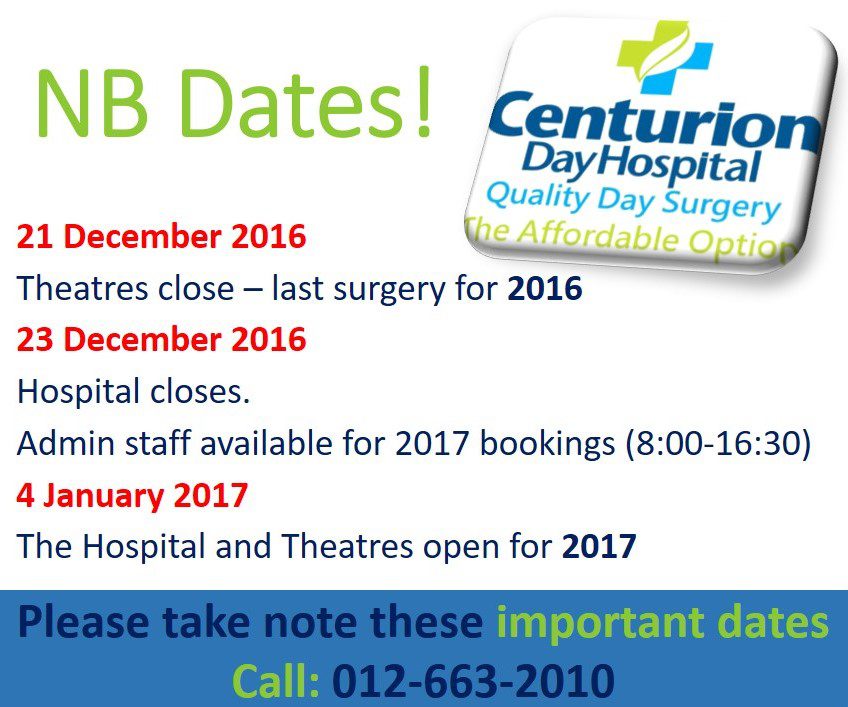
Important Hospital Dates

Please take note of these important dates concerning Centurion Day Hospital closing in 2016 and opening in 2017.
We still have theater space available until 21 December, call 012-663-2010 to book a procedure. 

21 December 2016  
Theaters close – last surgery for 2016

23 December 2016
Hospital closes.
Admin staff available for 2017 bookings (8:00-16:30)

4 January 2017
The Hospital and Theaters open for 2017

Categories
Welcome to new doctor

Welcome Dr. Karen Minnaar

We welcome Dr. Karen Minnaar, she is a Gynaecologist situated in Centurion. Dr Minnaar is specialised in Obstetrics and Gynaecology where she qualified at the University of Pretoria.

Contact her at 012-664-2979

Categories
News

MediNews: Too Many Kids Still Eating Too Much Salt

9 out of 10 exceed daily recommendations, CDC researchers find

By Robert Preidt 
HealthDay Reporter

THURSDAY, Nov. 3, 2016 (HealthDay News) — American children’s high salt intake puts them at risk for heart disease later in life, a new study warns.
Nearly 90 percent of U.S. kids consume more than the recommended amount of salt for their age, researchers from the U.S. Centers for Disease Control and Prevention discovered.
Sodium-heavy breads, pizza, cold cuts, processed snacks and soups are among the major culprits, according to the report. “We already know that nearly all Americans regardless of age, race and gender consume more sodium than is recommended for a healthy diet, and the excess intake is of great concern among particular youths,” lead author Zerleen Quader said. Quader is a data analyst in the CDC’s Division for Heart Disease and Stroke Prevention.

The researchers analyzed 2011-2012 data from more than 2,100 children, aged 6 to 18, nationwide. The kids’ average salt intake was 3,256 milligrams (mg) a day, not including salt added at the table, the investigators found.
Recommended salt intake for children varies from 1,900 mg to 2,300 mg a day, depending on age. The researchers also found that average levels of salt intake were especially high among teens aged 14 to 18 (3,565 mg daily). Girls had much lower daily intake than boys — 2,919 mg a day versus 3,584 mg a day, according to the report.

When and where are kids getting all this salt?
Dinner accounted for 39 percent of children’s salt intake and lunch for 31 percent, the study found. Breakfast and snacks each provided roughly 15 percent of salt intake. Ten types of food accounted for almost half of kids’ salt intake: pizza, Mexican mixed dishes, sandwiches (including burgers), breads, cold cuts, soups, savory snacks, cheese, plain milk and poultry, the researchers said.

Foods bought at grocery stores provided 58 percent of children’s daily salt intake. Fast-food and pizza contributed 16 percent, and school cafeterias 10 percent, according to the study. The results were published Nov. 3 in the Journal of the Academy of Nutrition and Dietetics. “With the exception of plain milk, which naturally contains sodium, the top 10 food categories contributing to U.S. school children’s sodium intake in 2011-2012 comprised foods in which sodium is added during processing or preparation,” Quader said in a journal news release.

It’s known that salt can increase blood pressure in some people. Previous research indicates that one in nine children aged 8 to 17 already has above-normal blood pressure, which boosts their risk of high blood pressure as adults. High blood pressure — also called hypertension — increases the risk of heart disease. “Sodium reduction is considered a key public health strategy to reduce the risk of cardiovascular diseases nationwide, and this study is the latest in ongoing CDC efforts to monitor U.S. sodium intake,” Quader said.

But curbing salt consumption can be challenging, the researchers noted. Ultimately, salt must be reduced across the U.S. food supply, Quader noted. For families, though, the best way to reduce salt intake is to check the Nutrition Facts panel on packages and look for no-salt-added or lower-sodium versions, Quader said. Foods with less than 140 mg per serving are considered low in sodium. Also, feed your children a diet rich in fresh fruits and vegetables without added sodium or sauces. And you can request nutritional information at restaurants to find healthier options, Quader suggested.

WebMD News from HealthDay
Source

Categories
Welcome to new doctor

Welcome Dr. Colleen Krog

Centurion Day Hospital is very pleased to welcome Dr. Colleen Krog to our team. She is an Aneasthetist with a special interest in Paediatrics, Vascular surgery and Cardiology. Dr. Krog has an additional qualification in Critical Care and enjoys reading, music, running and travelling in her free time. We are looking forward to a long relationship with you Dr. Krog!
Categories
News

Press Release 16 Nov 2016: Project Open Hearts donates 8 smiles for Christmas

Press release
Centurion Day Hospital
16 November 2016 

Project Open Hearts donates 8 smiles for Christmas
-Centurion Day Hospital gave an early Christmas gift to children.

On Wednesday 16 November 2016, Centurion Day Hospital has made its theaters and facilities available for the second time this year to accommodate needy patients in desperate need of dental day procedures. Seven of the eight children that benefited from this project in November come from a community organisation in Pretoria, Smile of Joy, who assists HIV positive orphans and vulnerable with dental procedures. According to Mrs Elmarie Marais, General Manager of Centurion Day Hospital, Project Open Hearts aims to give back to the public by showing the open hands and harts of the medical community and thereby changing lives.
“Smile of Joy HIV Orphans Oral Care is very grateful to Centurion Day Hospital for the free treatment of 7 more of our children”, said Amori Booysen, Smile of Joy Project Manager. “These children in need of procedures, each consisting of the removal of at least 5 teeth, received a real Christmas gift from the hospital. These procedures would otherwise not have been possible in 2016. The kids really experienced a lot of pain and discomfort before the procedures, but with this gift they will have a painless Christmas. The hospital and staff gave each child a reason to smile!”. Centurion Day Hospital made this a memorable experience for the patients with gift bags, balloons, snacks and a delicious lunch for sore throats and empty tummies after the procedure. “Surgery can be a very stressful experience, but our children friendly facility and staff will make sure everybody will have a positive hospital experience”, said Marais.
Centurion Day Hospital launched Project Open Hearts in September and performed 11 procedures free of charge of which 8 children were from Smile of Joy HIV Orphans Oral Care. The procedures formed part of National Dental Health Month together with the Pretoria branch of SADA (South African Dental Association). Through this project, Centurion Day Hospital offer their theatres and ward facilities and contribute the anaesthetics and medicine for recovery. The children had to undergo dental procedures in hospital under anaesthetics because it would be too traumatic to have it done in a dental chair. Together with the procedures done in September, it brings the total number of smiles changed this year to 19. “With the rising cost in medical aid and increasingly more people struggling to afford much needed procedures, we hope to change many more lives in 2017!”, said Marais.
Centurion Day Hospital opened the doors of their new facility earlier this year and is excited about the opportunity to bring services to the heart of Centurion where there is a need for day procedure facilities. Worldwide up to 60% of surgical procedures can be done in a day hospital where the costs is much lower than in an acute hospital. A day hospital is a hospital where smaller day procedures are executed and patients don’t stay overnight. Some of the procedures include dental surgery, certain surgical procedures, ear, nose and throat procedures, gynaecology, maxillofacial & oral surgery, cosmetic surgery, orthopaedic surgery and endoscopic procedures carried out by specialists.

Mediaverklaring
Centurion Day Hospital
16 November 2016

Project Open Hearts skenk 8 glimlagte vir Kersfees
– Centurion Day Hospital gee vroeë kersgeskenk vir kinders.

Op Woensdag 16 November 2016, het Centurion Day Hospital die tweede keer die jaar hul teaters en fasiliteite gratis aangebied om behoeftige pasiënte wat tandheelkundige prosedures benodig, te laat opereer. Sewe van die agt kinders wat in November hierby gebaat het, is verbonde aan ‘n gemeenskapsorganisasie in Pretoria, Smile of Joy, wat tandheelkundige hulp aan behoeftige HIV wees-en-kwesbare kinders bied. Volgens Mev Elmarie Marais, Algemene Bestuurder van Centurion Day Hospital, vorm die gratis prosedures deel van die hospitaal se gemeenskapsprojek, Project Open Hearts wat ten doel het om terug te gee aan die publiek deur die oop hande en harte van die mediese gemeenskap te wys en daardeur lewens te verander.

“Smile of Joy HIV Orphans Oral Care is hartlik dankbaar  vir die kostevrye behandeling van nog 8 van ons kinders deur Centurion Dag Hospitaal”, sê  Amori Booysen, Smile of Joy se Projekbestuurder. “Hierdie kindertjies wat teater behandeling benodig, dit behels ‘n minimum van 5 tande wat getrek moet word, het ‘n ware kersgeskenk van die hospitaal ontvang. Die prosedures sou andersins nie in 2016 moontlik gewees het nie. Die kinders het erge pyn en ongemak ervaar voor die prosedures en nou gaan hulle ‘n pynlose Kersfees beleef. Die hospitaal en personeel het elke kindjie ‘n rede gegee om te glimlag! ” Die Centurion Day Hospital het die dag ‘n baie aangename ondervinding vir die klein pasiëntjies gemaak met geskenkpakkies, ballonne, lekker happies en ‘n heerlike ete vir die seer kele en honger magies na die tyd. “Chirurgie kan baie spanningsvol wees, maar ons kindervriendelike fasiliteite en personeel verseker dat almal ‘n positiewe hospitaal ervaring het”, volgens Marais.

Centurion Day Hospital het met Project Open Hearts afgeskop in September en 11 prosedures gratis gedoen tydens Mondgesondheidsmaand in samewerking met die Pretoria tak van SADA (South African Dental Association), waarvan 8 kinders van Smile of Joy HIV Orphans Oral Care was. Deur die projek, bied Centurion Day Hospital die teater en saal fasiliteite aan, asook die medikasie nodig vir herstel en narkose. Die kinders se tandheelkundige prosedures moes onder narkose gedoen word omdat dit vir hulle te traumaties sou wees om die prosedures in die tandarts stoel te ondergaan. Saam met die prosedures in September bring dit die totaal op 19 glimlagte wat verewig verander is. “Met die stygende koste in mediese fondse en toenemend meer mense wat sukkel om nodige prosedures te kan bekostig, hoop ons nog om vele meer lewens te verander in 2017”, volgens Marais.

Centurion Day Hospital het vroeër vanjaar in Mei die deure van hulle nuwe fasiliteite geopen en is baie dankbaar vir die geleentheid om in die hart van Centurion meer pasiënte te kan raak wat behoefte het aan fasiliteite vir dagprosedures.  Wêreldwyd kan meer as 60% van chirurgiese prosedures in daghospitale uitgevoer word waar kostes heelwat laer is as in akute hospitale. ‘n Daghospitaal is ‘n hospitaal waar kleiner dagprosedures uitgevoer word en pasiënte nie in die hospitaal oornag nie. Van die prosedures wat geakkommodeer word, is tandheelkundige prosedures, oor, neus en keel prosedures, ginekologiese prosedures, kosmetiese chirurgie, ortopediese chirurgie, endoskopiese prosedures, mond-en-kaak chirurgie en nog vele meer.